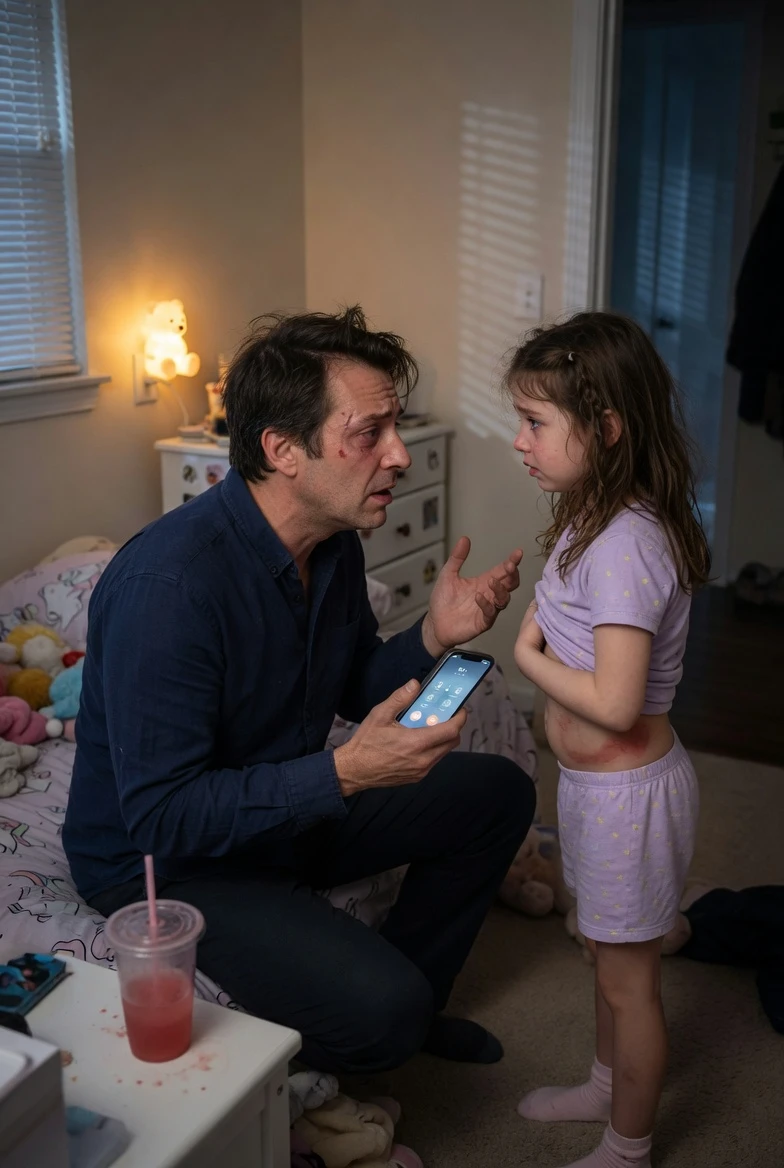
The headlights slid across Sophie’s wall in one long sweep.
White. Then gold. Then gone.
My wife was in the driveway.
I was still in my daughter’s room with proof in my hand and fear standing barefoot in front of me. Sophie had pulled her pajama shirt back down, but the bruise was burned into my mind so clearly I knew I would see it every time I closed my eyes for the rest of my life.
I made one call before the car door outside even shut.
My sister answered on the second ring.
“I need you here now,” I said.
She stopped talking immediately.
I looked at Sophie. She was still twisting the hem of her shirt, still listening for her mother’s footsteps, still trying to be smaller than the room.
“I’ll tell you when you get here. Just come fast.”
I hung up and took three quick photos with my phone.
First the texts my wife had sent me.
Then the pink juice cup on the nightstand.
Then, after asking Sophie softly and promising I’d be gentle, the bruise on her back.
No flash.
No panic.
Just evidence.
The front door opened downstairs.
Keys landed in the ceramic bowl by the entryway. Grocery bags rustled. Then my wife’s voice came through the hall, light and casual in that polished way people use when they think the story still belongs to them.
Sophie flinched before I did.
That was enough.
I didn’t move her. Didn’t send her to another room. Didn’t tell her to go hide in the bathroom while the adults “talked.” She had already spent too long being managed.
“You stay with me,” I told her.
A few seconds later my wife appeared in the bedroom doorway with her purse still over one shoulder and a supermarket receipt curled in one hand.
She smiled automatically.
Then she saw my face.
Then Sophie’s.
Then the closed bedroom door.
The smile vanished.
“What’s going on?” she asked.
Too calm.
Too quick.
Too practiced.
I stood slowly, making sure I was between her and Sophie without making a performance of it.
“You tell me.”
Her eyes flicked to Sophie first.
That look lasted maybe half a second.
Most people would have missed it.
I didn’t.
It was not concern.
It was warning.
Sophie stepped closer to my leg.
That tiny movement told me more than anything my wife was about to say.
“She had a hard day,” my wife said. “Big feelings. She spilled juice everywhere and threw herself backward when I tried to help her.”
The lie came out clean.
Ready.
As if she had already repeated it to herself enough times to believe it.
I asked one question.
“Why did you tell me she was fine?”
She adjusted the purse strap on her shoulder. “Because I handled it.”
Behind me, Sophie made the smallest sound in her throat.
Fear again.
Not pain.
Fear.
That was the moment I realized my daughter already knew the difference between what happened and what would be said about what happened.
“Can we not do this in front of her?” my wife asked.
That sentence nearly ended the marriage right there.
Not “Is she okay?”
Not “Should we take her in?”
Not “What did she tell you?”
Just damage control.
Just optics.
“In front of her,” I said, “is exactly where this started.”
Sophie spoke then, so quietly I almost missed it.
“I’m not confused.”
The room changed.
My wife went very still.
Sophie kept staring at the carpet.
“You pushed me,” she said.
My wife’s voice sharpened immediately. “Sophie—”
“And you said not to tell Dad.”
I felt Sophie’s shoulder press into my leg, and I knew those words had cost her everything she had.
My wife turned to me with that cold flatness people save for the moment they know they’re being seen too clearly.
“That is not what happened.”
I took out my phone and let her see it.
“The texts say otherwise. The bruise says otherwise. And Sophie says otherwise.”
She went pale around the mouth.
Then came the line I think she believed would still work.
“You’ve been gone four days. You walk in here and think you know everything?”
No.
I walked in and found out how much had been hidden.
My sister arrived two minutes later and came into that room like a witness, not a guest. She took one look at Sophie’s face and sat on the bed beside her without asking anything dramatic. Just opened one arm and let Sophie decide.
Sophie moved toward her.
That alone told my wife the room was no longer hers to control.
I called the pediatric urgent line first.
Not the police.
Not my lawyer.
The nurse heard enough to interrupt me before I even finished.
“Bring her in tonight.”
Not tomorrow.
Not watch and wait.
Tonight.
My wife tried to insist she should come with us.
Sophie went rigid the second she heard that.
So I answered for both of us.
“No.”
At the front door, Sophie froze. She looked up at me with wet lashes and asked the question that will live in my chest forever.
“Am I in trouble?”
I knelt right there by the shoe bench, with the rain smell coming in from outside and my sister holding the car door open, and said, “No, sweetheart. Never for telling the truth.”
Urgent care was all fluorescent lights, paper forms, and soft voices trained not to break children who were already holding themselves together as hard as they could. Sophie sat curled in a blanket with her stuffed fox from the waiting room prize shelf while the doctor examined her back.
The doctor’s face changed before she even spoke.
That told me enough.
“This is consistent with direct impact,” she said quietly. “I want imaging.”
Consistent with direct impact.
Clean words.
Clinical words.
But they landed like concrete.
A social worker came next. Then another nurse. Then questions asked in a tone that let Sophie answer without feeling cornered. She told the story the same way each time.
Juice.
Angry.
Push.
Door handle.
Couldn’t breathe.
Don’t tell Dad.
Consistency.
That word matters more than adults think.
By 11:48 p.m., my wife had called fourteen times. Her mother called three. A family attorney texted once. I ignored all of them.
Then a police officer stepped through the curtain with a notebook in his hand and said, “Mr. Hayes, I need a statement.”
I looked over at Sophie curled in the hospital bed under a warm blanket, cheeks blotchy from crying, still clutching the stuffed fox like it was the only soft thing in the world she trusted.
And I knew the secret her mother thought would stay buried had already become a case.